A look inside order execution, liquidity, spreads and slippage.
You see a price, decide to take the trade and click Buy.
A moment later, a position appears on your platform. Most of your attention probably moves straight to the chart: where price is going, where your stop sits and whether your idea is playing out.
But something important has already happened between your decision and that position appearing.
Your instruction has been processed and a trade has been executed. The price you saw, the quantity you requested and the liquidity available all played a part. So did the way your broker handles orders.
As a trader and broker, I think this deserves more attention. Traders can spend a lot of time studying entries without being equally familiar with how those entries become actual trades.
Understanding that process helps explain spreads, slippage and why clicking Buy does not always mean getting the exact price you had in mind.
First, what are you trading?
There isn’t one order journey that applies to every market.
An exchange-traded futures contract can trade through a central order book, where buying and selling interest is organised by price. An order for an exchange-listed share may be routed to an exchange or another execution venue, including a market maker. Even in shares, the broker’s execution arrangements matter. Sources: CME Group on central order books, Investor.gov on stock execution.
Retail over-the-counter forex and CFDs need a different explanation. These are not automatically transactions on a central exchange. In a CFD arrangement, your provider may be your contractual counterparty, with separate arrangements for managing or hedging the exposure created by your trade. Source: ESMA’s guidance on CFDs and other speculative products.
For this article, the main reference point is a retail OTC forex or CFD trade. Where an order-book example helps explain liquidity, we’ll identify it as such.
That distinction matters. The platform is the interface you use; it does not, by itself, tell you the execution model behind it.
Your click sends an instruction
The instruction depends on the order type.
A market order requests execution at available prices. It does not lock in the quote you just saw.
A limit order sets a price boundary: a buy limit should execute at the limit price or lower, while a sell limit should execute at the limit price or higher. That control comes with a trade-off: the order may remain unfilled. The precise handling depends on the product and execution rules. Source: Investor.gov’s guide to order types.
Your order also passes through the broker’s systems. Checks can include whether the instrument is available to trade, whether the requested size is permitted and whether sufficient margin is available. For a concrete example of how these controls and execution arrangements are documented, see OANDA’s execution policy.
An accepted instruction then follows the execution process applicable to that account and instrument. A rejected instruction does not become a trade simply because you pressed the button.
The price on screen has a quantity behind it
A price is only part of the picture. The amount available at that price matters too.
Consider this simplified order-book example.
Illustrative example only. These are hypothetical prices and quantities, not actual market data.
You submit a market order to buy 100 units. The available sell orders are:
- 40 units at 100.00
- 35 units at 100.02
- 25 units at 100.05
Assuming those orders remain available and the execution rules allow the purchase to continue through these levels, your order fills in three portions.
The average purchase price is 100.0195, before fees.
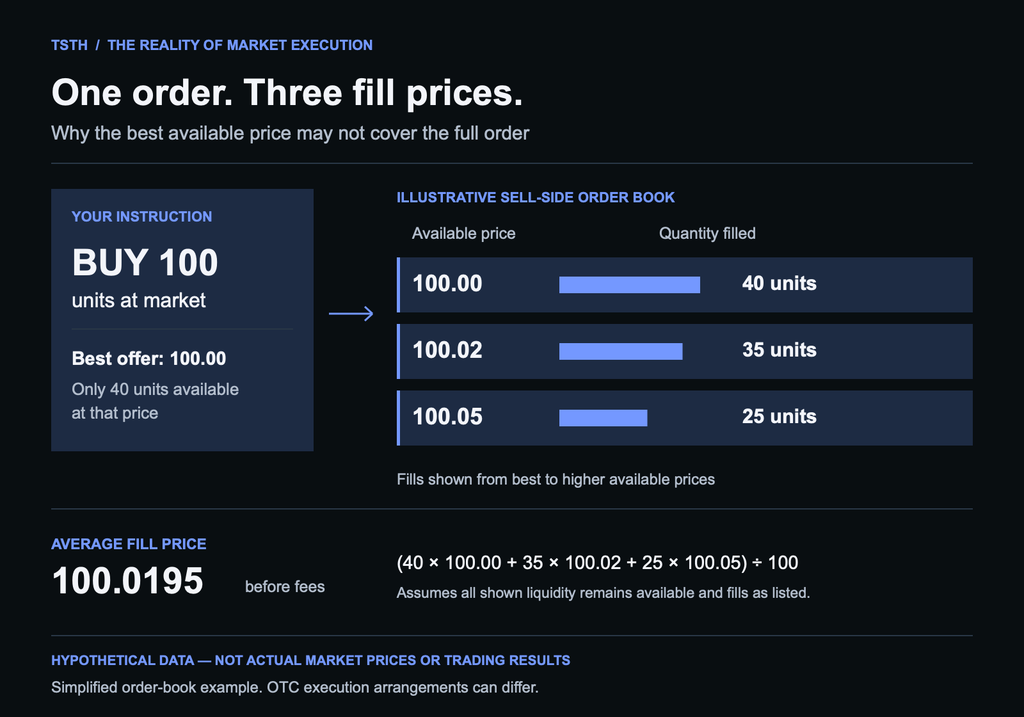
The best displayed offer was 100.00, but only 40 units were available there. Buying the full 100 required taking liquidity at additional prices. CME’s liquidity methodology uses this same principle when measuring the cost of trading beyond the quantity available at the top of its order book. Source: CME Group’s liquidity methodology.
This is why “large” needs context. An order is large relative to the liquidity available to absorb it.
In OTC execution, the available prices, quantities and handling rules depend on the broker’s arrangements and liquidity relationships. You should not assume that a depth display represents a single, complete view of the entire forex market. FX trading is fragmented across different venues and relationships. Source: BIS on the structure of FX execution.
Slippage is part of the equation
Slippage is the difference between the price used as your reference and the price at which the trade actually executes.
For a buy order, a higher execution price is unfavourable slippage. A lower price is favourable slippage.
Prices can change while an instruction is travelling or being processed. Available quantity can change too. Volatile conditions may also produce partial executions or several transactions at different prices. These possibilities are explicitly described in broker execution policies, including OANDA’s policy.
Slippage is therefore a real execution risk. But that does not mean every unexpected fill should be accepted without examination.
My view is that traders should understand both the market explanation and the broker’s explanation. A difference in price, by itself, does not establish its cause.
Also, spread and slippage are different things.
Suppose the quote is 1.10000 bid and 1.10010 ask. Buying at 1.10010 rather than the bid is not, by itself, slippage. You are comparing the two sides of the quote. To assess slippage, you need an appropriate reference price for the instruction you submitted.
Did your order reach a liquidity provider?
A fill confirmation alone usually cannot answer that question.
In OTC markets, executing your trade and managing the broker’s resulting exposure are connected activities, but they are not necessarily the same transaction.
A broker may retain exposure, hedge it externally or manage it alongside other client positions. Internalisation can involve matching offsetting client flows on the dealer’s own books rather than immediately passing the imbalance into the inter-dealer market. Source: BIS’s definition of internalisation.
A broker can therefore use external pricing and routing infrastructure without every client trade producing an identical, immediate external hedge.
The relevant questions are: who is your contractual counterparty, where is your trade executed, and what do the broker’s disclosures say about its hedging arrangements? ESMA’s guidance specifically addresses transparency around these distinctions. Source: ESMA’s CFD guidance.
Why the spread keeps changing
The bid is the quoted selling price available to you; the ask is the quoted buying price. The difference is the spread.
There is a commercial side to this. The firms providing prices and execution operate businesses, take risks and charge for their services.
But treating the whole spread as a simple broker fee misses part of the picture. Underlying liquidity and volatility affect pricing. A broker’s markup or separate commission adds another consideration. For example, OANDA documents both variable spreads linked to market conditions and a pricing model combining core spreads with commission. Sources: spread conditions, core spreads plus commission.
Some products offer fixed spreads under specified conditions. Others use variable spreads. Check which arrangement applies rather than assuming the difference between bid and ask will remain constant.
Where execution technology fits
This is where aggregation and routing technology become relevant.
Tradeview describes EDGE, its Instant Liquidity Connector, as infrastructure behind MT4 and MT5 that combines pricing from multiple liquidity providers and automatically routes orders. Those are Tradeview’s published product descriptions, rather than an independent assessment of execution performance. Source: Tradeview’s EDGE overview.
Accessing multiple pricing sources is intended to support price discovery and execution. It does not make available liquidity unlimited or remove the possibility of slippage.
I work with Tradeview Markets, and TSTH’s Tools & Solutions page explains EDGE in that context. The useful question is what the technology does between your instruction and the resulting fill—and how it performs under the conditions you trade.
What to check after a fill
You don’t need to become an execution specialist to ask better questions.
Start with these:
- What product am I trading, and who is my counterparty?
- Which order type did I submit?
- Was my reference price the bid, ask or last-traded price?
- What quantity did I request, and what quantity filled?
- Does the trade record show separate fills or an average price?
- What spread, commission and other charges applied?
- What does the execution policy say about slippage, partial fills and order handling?
If a fill needs investigating, keep the order reference, timestamps and trade details. Those give the discussion something concrete to work from.
Clicking Buy is the visible step. Understanding what follows helps you judge the trade you actually received.
It also opens up the next question: why can two brokers show different prices for what appears to be the same market?
Oliver García is a trader and Broker & Market Specialist at Tradeview Markets. This article is for educational and informational purposes and is not a personal investment recommendation. Trading involves risk.